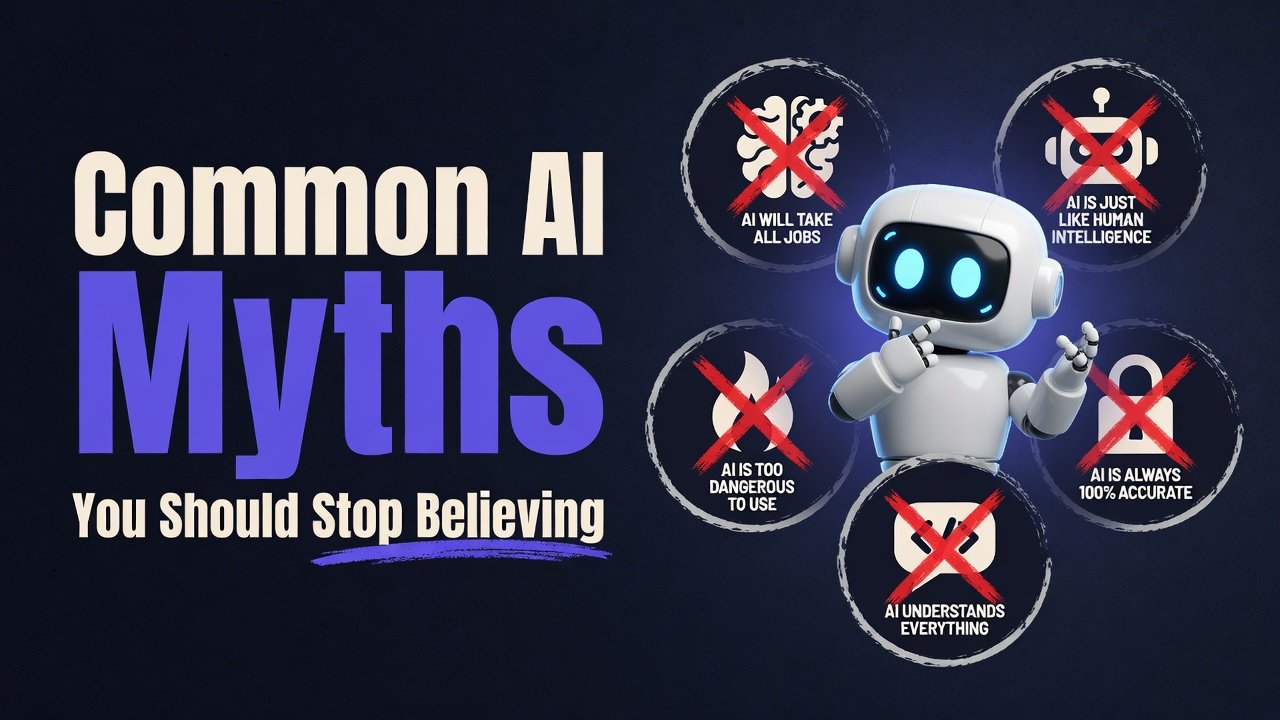
The speed at which artificial intelligence has evolved over the last few years has created a massive gap between what AI actually does and what people think it does. Pop culture, heavy marketing, and sci-fi tropes have blurred the lines, leaving us with a lot of misconceptions.
Let’s clear the air and separate the math from the myth.
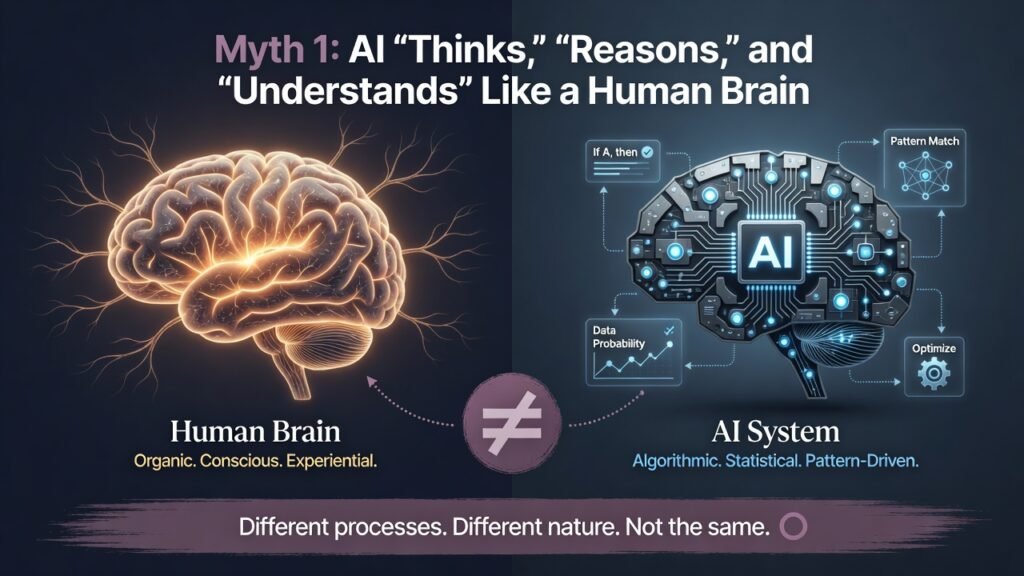
Myth 1: AI “Thinks,” “Reasons,” and “Understands” Like a Human Brain
The fluid, conversational nature of modern artificial intelligence makes it incredibly easy to anthropomorphize. When an AI offers a comforting response or solves a complex riddle, it feels like there is a conscious mind at work. However, AI does not possess a single shred of comprehension, consciousness, or internal life. It operates entirely as a highly sophisticated probability engine.
When you type a prompt into a Large Language Model (LLM), the system does not ponder your question or access a repository of conceptual knowledge. Instead, it converts your words into numerical representations called tokens. It then runs these tokens through billions of mathematical weights to calculate a simple statistical probability: “Given this sequence of words, what is the most likely next word?” It repeats this process word by word.
An AI “knows” that the word “apple” is frequently associated with “pie,” “tree,” and “technology” based on patterns in its training data, but it has absolutely no sensory or conceptual understanding of what a crisp, juicy apple actually is. Human reasoning relies on mental models of the physical world, lived experiences, emotional states, and intent. AI completely lacks this architecture; it is essentially a hyper-advanced version of the predictive text feature on your smartphone, scaling up mathematical patterns to mimic the appearance of thought without any of the underlying substance.
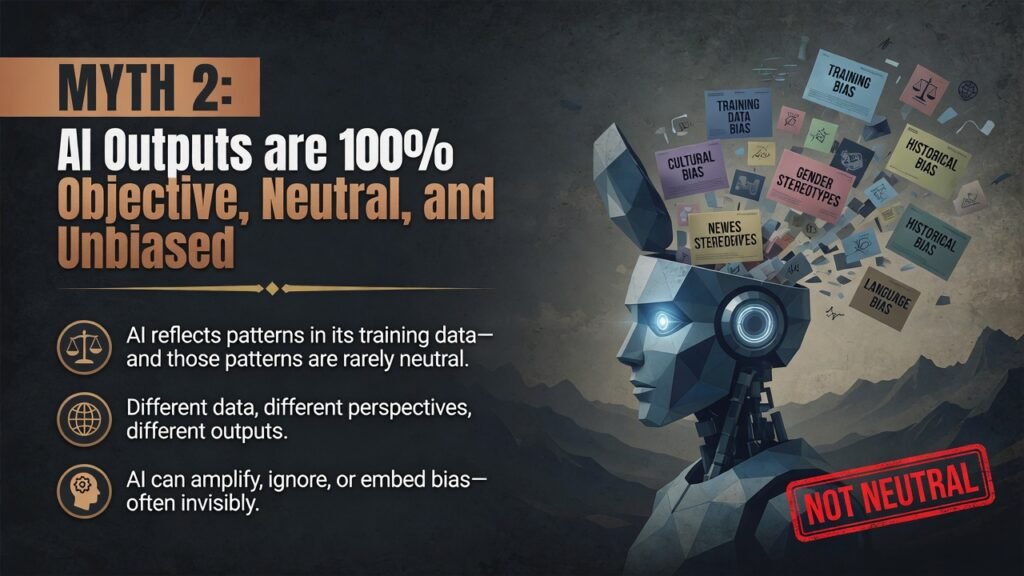
Myth 2: AI Outputs are 100% Objective, Neutral, and Unbiased
Because computers do not possess human emotions, personal grudges, or political affiliations, there is a dangerous assumption that their decisions are perfectly neutral and objective. This is fundamentally false. An AI model is entirely a reflection of the data used to train it, meaning it acts as a digital mirror to human history—complete with all our systemic biases, cultural prejudices, and historical inequities.
If an AI tool is designed to screen resumes for a tech company and is trained on historical data from the past twenty years, it will look at who was successfully hired and promoted in the past. If that historical workforce was overwhelmingly male due to societal biases, the AI will mathematically deduce that being male is a statistical predictor of success. It doesn’t “know” it is discriminating; it is simply optimizing for the patterns it was given. Consequently, it may quietly penalize resumes containing the word “women’s” (e.g., “captain of the women’s lacrosse team”).
Biases creep into AI systems through data collection gaps, unrepresentative sampling, and the human biases of the engineers who label the data. When we rely blindly on AI for high-stakes decisions like criminal sentencing, mortgage approvals, or medical triage, we risk automating and magnifying historical discrimination under the false guise of mathematical mathematical objectivity.
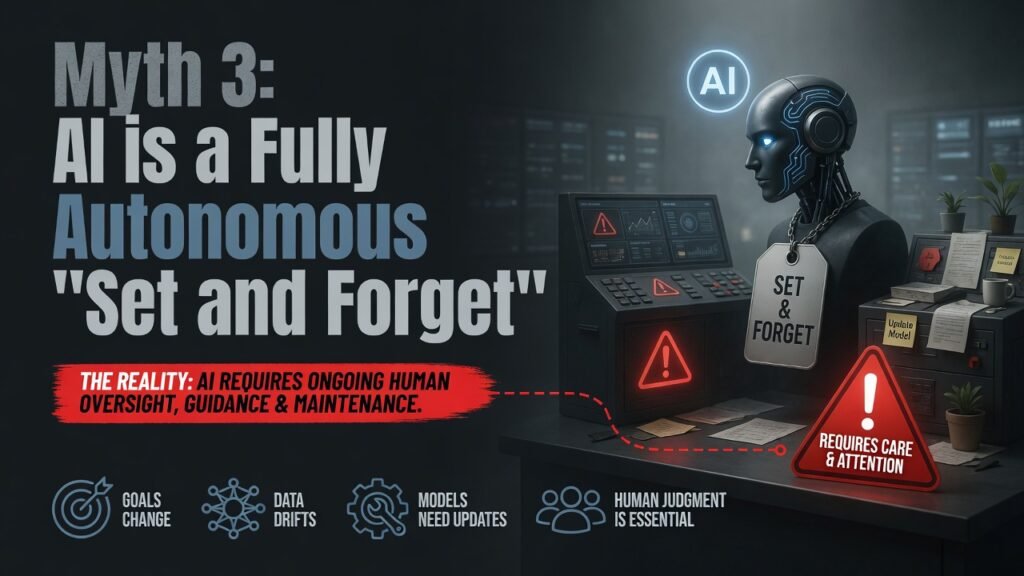
Myth 3: AI is a Fully Autonomous “Set and Forget” Technology
A common misconception in corporate and mainstream circles is that once an AI system is built, trained, and deployed, it can run indefinitely on its own, seamlessly adapting and managing itself without human intervention. In reality, AI infrastructure requires massive, continuous human maintenance, monitoring, and engineering to prevent it from rapidly breaking down or becoming obsolete.
This degradation happens primarily due to a phenomenon known as “data drift” or “concept drift.” AI models are trained on a static snapshot of data from a specific point in time. However, the real world is constantly changing. For instance, a highly accurate predictive model built to flag fraudulent credit card transactions before a global economic shift might completely fail during a sudden recession because consumer spending habits drastically alter. The model’s assumptions no longer align with reality.
Furthermore, AI systems suffer from “model degradation” if they are allowed to continuously learn from their own outputs or uncurated internet data, eventually leading to a collapse in quality. Human-in-the-loop oversight is strictly mandatory. Engineers, data scientists, and domain experts must constantly audit AI decisions, manually filter toxic inputs, retrain models with fresh data, and hardcode safety rails to keep the system accurate, secure, and legally compliant. Far from being self-sustaining, AI is one of the most high-maintenance software technologies ever created.
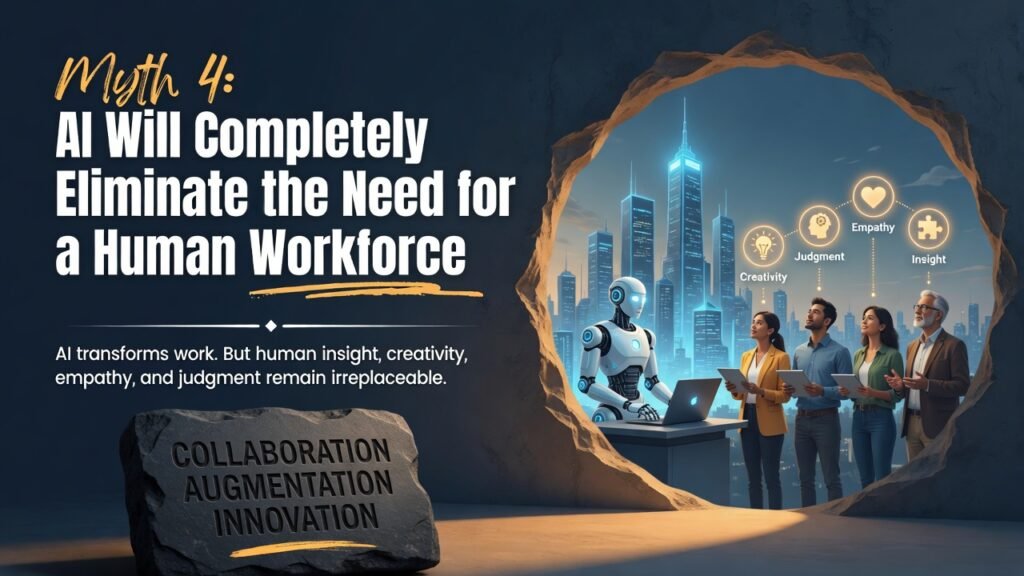
Myth 4: AI Will Completely Eliminate the Need for a Human Workforce
Fears of mass unemployment driven by a rogue wave of automation have dominated headlines, painting a dystopian picture of future factories and offices completely devoid of human beings. While AI is undeniably an industrial-scale disruptor, the narrative of total human obsolescence ignores the fundamental limitations of the technology and the historical evolution of labor.
AI excels at automating repetitive, predictable, and data-heavy tasks. It can parse thousands of legal documents in seconds, draft standard emails, or write basic code blocks. However, it completely stalls when a task requires genuine emotional intelligence, physical adaptability, nuanced ethical judgment, or abstract creative strategy. An AI can generate a standard marketing template, but it cannot understand the deep cultural anxieties of a target audience to craft a truly groundbreaking, original campaign. It can suggest a medical diagnosis based on symptoms, but it cannot deliver that news to a patient with empathy and handle the complex, unpredictable human reaction.
Historically, major technological shifts—like the Industrial Revolution or the rise of the personal computer—eliminated specific jobs but created entirely new industries and increased the demand for specialized human labor. The realistic future of work is not AI replacing humans wholesale, but rather AI-augmented humans replacing those who refuse to adapt. The technology shifts human value away from routine processing and places a premium on uniquely human cognitive skills.
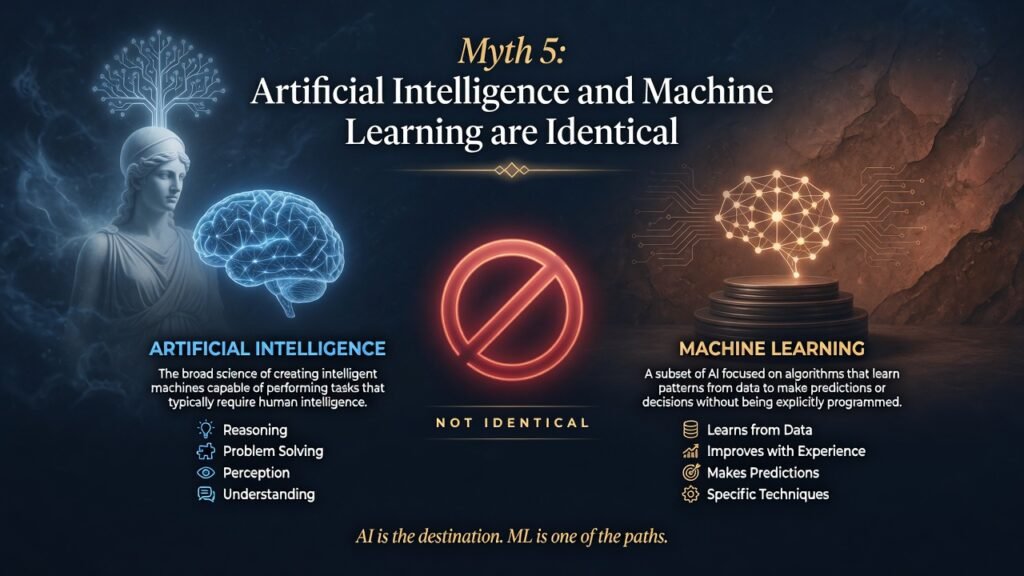
Myth 5: Artificial Intelligence and Machine Learning are Identical
In tech marketing and casual conversations, the terms “Artificial Intelligence” (AI) and “Machine Learning” (ML) are constantly used as interchangeable buzzwords. This creates a confusing landscape where the distinct boundaries of these technologies are completely lost. To understand the field, one must realize that AI is a vast, overarching scientific discipline, while Machine Learning is merely a single, specific methodology within that broader domain.
Artificial Intelligence is the umbrella concept that covers any technique that enables a machine to mimic human behavior or intelligence. This includes old-school “expert systems” from the 1980s, which relied on rigid, human-written “if-then” rules to solve problems (like a chess computer that calculates every move based on hardcoded strategies). These older systems are absolutely AI, but they do not feature any machine learning whatsoever because they cannot adapt beyond their manual programming.
Machine Learning, on the other hand, is a specific branch of AI that revolutionized the field by ditching hardcoded rules. Instead of telling the computer exactly how to recognize a cat, engineers give an ML algorithm millions of images of cats and let the system mathematically figure out the defining features on its own. Within Machine Learning sits another subfield called Deep Learning, which uses multi-layered artificial neural networks to power modern tools like image generators and LLMs. Mixing up AI and ML is like using the words “vehicle” and “electric motor” interchangeably.
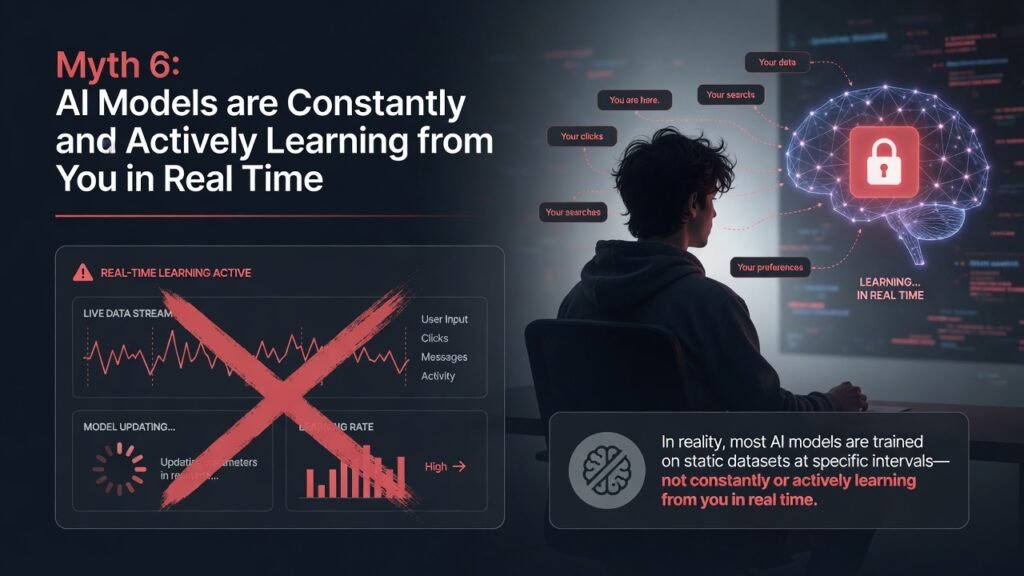
Myth 6: AI Models are Constantly and Actively Learning from You in Real Time
When you interact with a commercial AI chatbot and it remembers your name across a conversation, or seems to adapt its tone to your preferences, it is easy to assume that the model is actively evolving, learning new facts, and permanently rewriting its internal brain based on your input. This leads to intense privacy paranoia and a fundamental misunderstanding of how these models operate.
In reality, commercial AI models are frozen in time during their operational phase. The process of training an AI model requires massive supercomputing clusters, weeks or months of continuous processing, and millions of dollars in electricity. Once that training phase is complete, the model’s internal weights (its mathematical connections) are locked. When you chat with it, the model is in “inference mode.” It is static. It cannot permanently memorize a new fact you tell it, nor can it update its core database on the fly.
The illusion of real-time learning comes down to what is called a “context window.” The system temporarily passes your previous messages back into the probability calculator alongside your new prompt, allowing it to maintain the thread of the conversation. Once you close that chat session or clear the thread, that temporary memory is completely wiped clean from the active model. While companies may later collect user logs to package into a massive batch for future retraining months down the line, the AI you are talking to right now is not learning from you in real time.
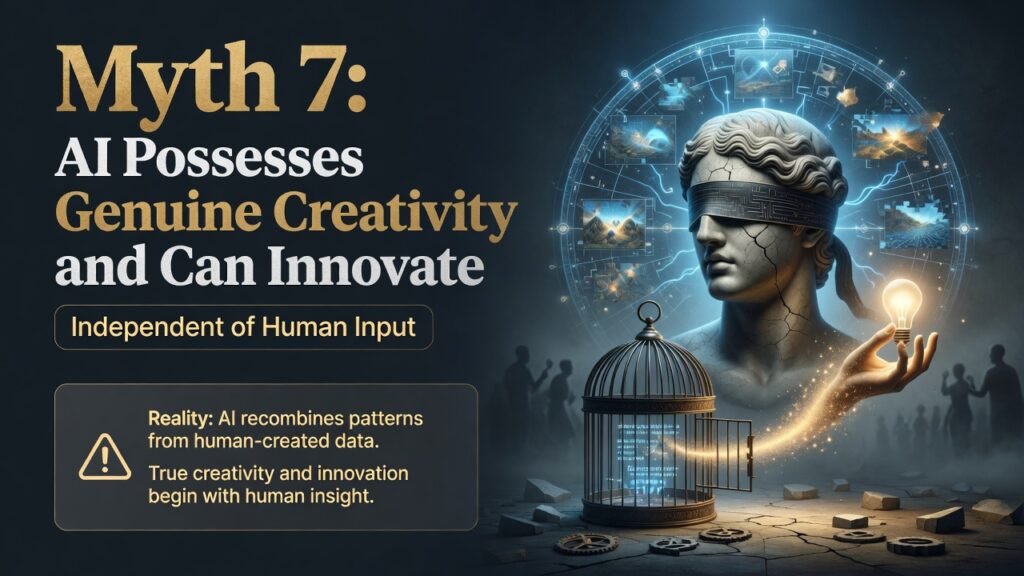
Myth 7: AI Possesses Genuine Creativity and Can Innovate Independent of Human Input
The explosion of AI-generated art, music, poetry, and prose has sparked a fierce philosophical debate over whether machines have achieved true artistic creativity. Because an AI can generate a breathtaking digital painting in the style of Rembrandt or compose a jazz melody in seconds, it appears to possess an innate creative spark. However, AI “creativity” is fundamentally derivative, lacking the essential element of human artistic innovation.
Human creativity is driven by a desire to communicate an internal state, a lived experience, an emotion, or a reaction to the world. It often involves breaking established rules to create something entirely unprecedented. AI, by contrast, operates purely by blending and interpolating existing human data. An image generation model works by analyzing millions of existing, human-made images that have text descriptions. When you ask it for an image, it identifies the statistical patterns, textures, and color structures associated with those words and blends them together mathematically.
The AI cannot invent a fundamentally new artistic movement because it cannot step outside the boundaries of its training data. It cannot experience grief, joy, or existential dread—the catalysts for the world’s greatest art. It is a highly advanced synthesizer of existing human expression. The true creativity in AI art still resides with the human who wrote the prompt, curated the output, and provided the conceptual spark that the machine merely executed.
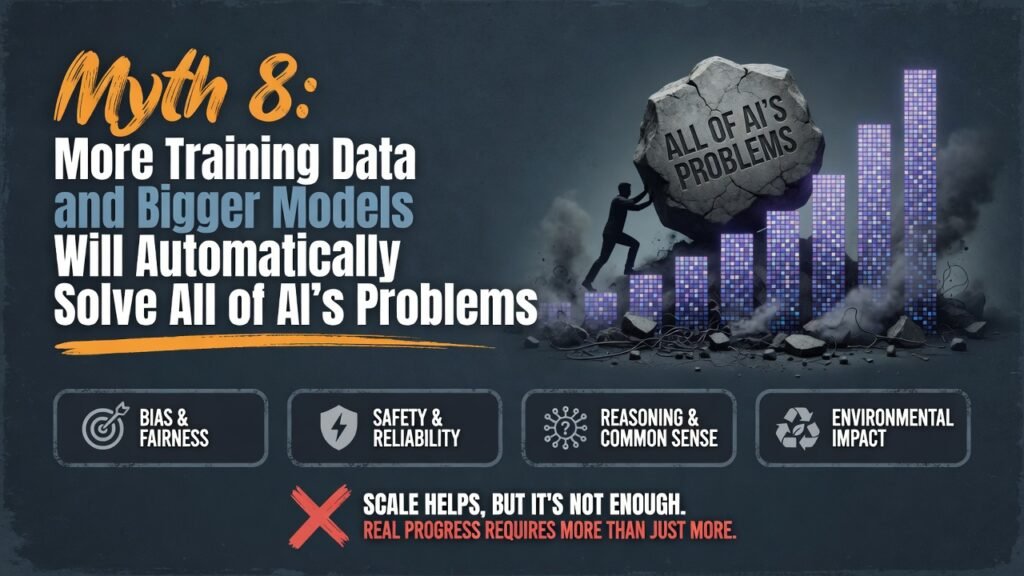
Myth 8: More Training Data and Bigger Models Will Automatically Solve All of AI’s Problems
For the past several years, the dominant philosophy among major tech companies has been “bigger is better.” The assumption was that if an AI model makes factual errors, hallucinates information, or struggles with logic, the solution is simply to feed it more data, give it more parameters (internal connections), and throw more computing power at it. However, the industry is hitting a wall that proves scaling up size does not inherently fix structural flaws.
First, we are facing a looming “data wall.” AI models have already consumed a massive portion of the high-quality, publicly available written text on the internet. Simply adding low-quality data or AI-generated text into the mix actually degrades the model’s performance, a problem known as “model collapse.” Second, increasing the size of a model does not change its underlying architecture. Because LLMs are fundamentally predictive text engines, making them bigger makes them more fluent and persuasive, but it does not make them inherently capable of fact-checking themselves or understanding cause and effect.
A larger model will still confidently hallucinate a fake legal precedent or fail a simple logic puzzle if the statistical patterns mislead it. To solve complex issues like systemic misinformation, reasoning gaps, and extreme energy consumption, the industry cannot just rely on making models bigger; it requires fundamental architectural breakthroughs in how AI processes logic and verifies truth.
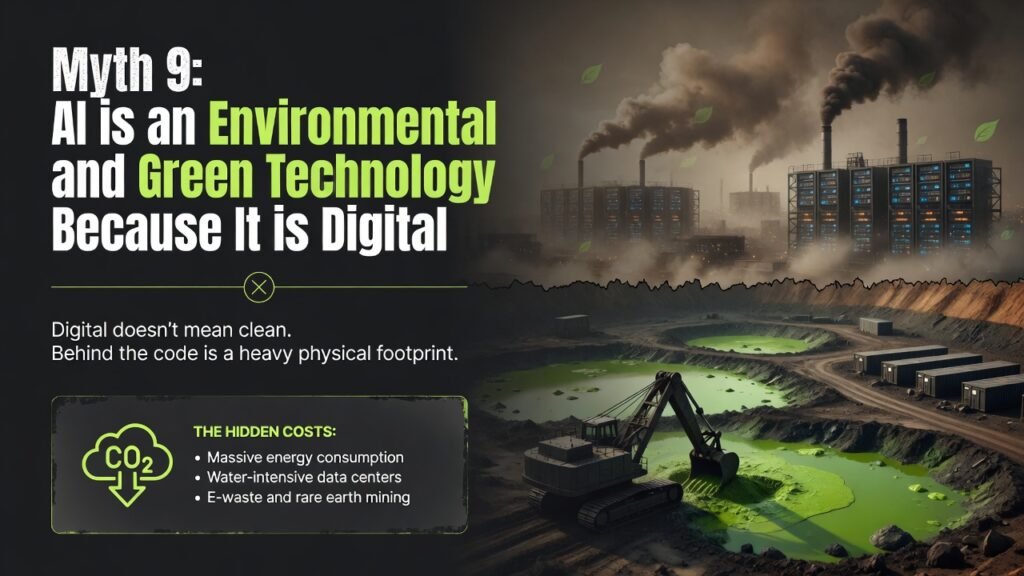
Myth 9: AI is an Environmental and Green Technology Because It is Digital
Because artificial intelligence exists purely in the cloud, on screens, and inside silent code bases, it is widely perceived as a clean, eco-friendly technology that reduces our reliance on physical resources. This digital illusion completely masks the staggering, highly physical environmental toll required to develop and operate modern AI infrastructure.
AI is incredibly resource-intensive. The lifecycle of a large AI model is split into two heavy-emission phases: training and inference. Training a single state-of-the-art model requires thousands of specialized graphic processing units (GPUs) running continuously for months inside massive data centers. These data centers consume immense amounts of electricity, much of which is still drawn from fossil-fuel-powered grids.
Furthermore, these server farms generate massive amounts of heat, requiring millions of gallons of fresh water every day to cool the machinery, often straining local water supplies in arid regions.
The environmental cost doesn’t stop once the model is trained. Every single time a user asks an AI chatbot to write an email, generate an image, or summarize a document, it requires a burst of computational power that is vastly more energy-intensive than a standard keyword search on Google. As millions of people integrate AI into their daily workflows, the collective carbon footprint and water usage of these data centers are skyrocketing, making AI one of the fastest-growing industrial consumers of energy on the planet.
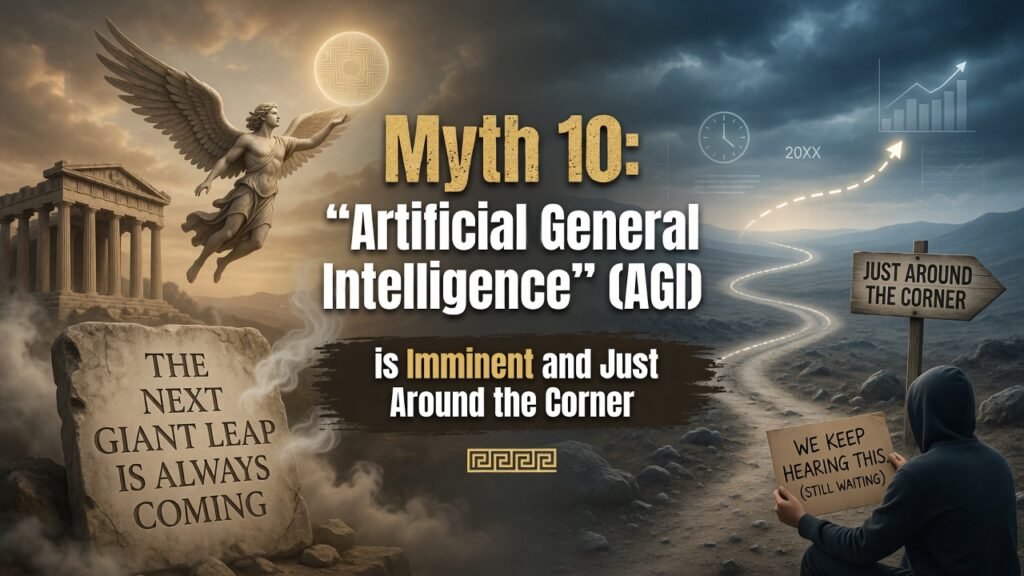
Myth 10: “Artificial General Intelligence” (AGI) is Imminent and Just Around the Corner
Fueled by breathless marketing campaigns and sensationalized media reporting, there is a widespread belief that we are just a year or two away from achieving Artificial General Intelligence (AGI)—the theoretical point where a machine possesses human-level intelligence across all domains, capable of teaching itself anything, adapting to any context, and potentially achieving self-awareness.
This timeline is highly unrealistic because it conflates progress in Narrow AI with progress toward General AI. Everything we use today, from autonomous driving systems to the most advanced chatbots, is Narrow AI. These systems are designed to operate within a specific, predefined sandbox (like generating text or identifying images). They cannot transfer skills natively. An AI that can beat the world champion at chess cannot use that strategic knowledge to figure out how to drive a car or diagnose a disease; it has to be built and trained from scratch for that new task.
True AGI requires common sense, conceptual understanding, the ability to learn from a single example (whereas current AI needs millions), and the capacity to navigate completely unfamiliar scenarios without new code. We currently do not have a scientific roadmap or a foundational technology that inherently leads to AGI. Our current breakthroughs are based on scaling up statistical pattern recognition, which is fundamentally different from building a conscious, adaptable mind. Most leading computer scientists agree that true AGI is decades away, if it is even achievable at all with our current computing paradigms.
FAQs
What is the biggest myth about artificial intelligence?
One of the biggest myths is that AI can think and feel exactly like humans. In reality, AI processes data and follows algorithms, but it does not have human emotions, consciousness, or self-awareness.
Will AI replace all human jobs?
No, AI is unlikely to replace all jobs. While it can automate repetitive tasks, many roles still require creativity, emotional intelligence, critical thinking, and human interaction.
Is AI always accurate?
No. AI systems can make mistakes, especially if they are trained on incomplete, biased, or outdated data. Human oversight is still important when using AI for important decisions.
Can AI learn completely on its own?
AI can improve through machine learning, but it still depends on data, training, and guidance created by humans. It does not independently develop knowledge the way humans do.
Is AI dangerous to humanity?
AI itself is not inherently dangerous. The real concern is how people design, deploy, and use AI systems. Responsible development and regulation are key to minimizing risks.
Does AI understand what it says?
Not in the same way humans do. AI can generate convincing responses by recognizing patterns in data, but it does not truly “understand” language with human awareness or intent.
Is AI only used by big tech companies?
No. AI is used by businesses of all sizes, healthcare providers, schools, financial institutions, retailers, and even individual creators for tasks such as automation, analysis, and content generation.
Can AI become smarter than humans overnight?
No. AI advancements happen through research, testing, and gradual improvements. Sudden overnight leaps to superhuman intelligence are a common misconception.
Is AI the same as a robot?
No. AI is software that enables machines to perform tasks that typically require human intelligence. A robot is a physical machine, and not all robots use advanced AI.
Should people stop learning skills because AI can do everything?
Definitely not. Human skills such as communication, creativity, leadership, problem-solving, and adaptability remain highly valuable. Learning new skills is more important than ever in an AI-driven world.